
Which Fiber Craft Is Right for You?
Knitting vs. Crochet vs. Spinning vs. Weaving
The Mountain and Valley Fiber Arts Festival will introduce you to multiple fiber arts in one weekend. You'll see spinners, weavers, knitters, crocheters, and felters all working in the same space. By Sunday, you might be confused about which path appeals to you.
This guide helps you understand the differences so you can walk into the festival (or choose your first workshop) with clarity, not anxiety.
The Core Question: What Does Each Craft Actually Do?
Before you get lost in pros and cons, understand what each craft fundamentally is:
Knitting: Creates fabric from one continuous yarn using two needles and interlocking loops.
The rhythm: Insert needle, wrap yarn, pull through, move to next loop. Repeat thousands of times.
The result: Stretchy, drapey fabric. Scarves, sweaters, socks, blankets.
Time to first finished object: 2-4 weeks (depending on project size)
Weaving: Interlaces two sets of yarn (warp and weft) at right angles to create fabric.
The rhythm: Set up loom with parallel threads, pass other threads through, create structure. Very methodical.
The result: Complex patterned fabric with visible structure. Scarves, table runners, wall hangings, blankets.
Time to first finished object: 2-6 weeks (depending on loom type and project)
Felting: Applies heat, moisture, and agitation to wool fibers until they bond together into non-woven fabric.
The rhythm: Depends on method (wet felting: wet, soap, agitate; needle felting: repeatedly poke with special needle)
The result: Dense, solid fabric. Toys, wall hangings, sculptures, bags, slippers.
Time to first finished object: 1-3 hours (one of the fastest!)
Crochet: Creates fabric from one continuous yarn using one hook and interlocking loops.
The rhythm: Hook yarn, pull through loops in a specific sequence. Repeat thousands of times.
The result: Slightly stiffer, textured fabric. Same projects as knitting, plus amigurumi (stuffed things), blankets, granny squares.
Time to first finished object: 1-3 weeks
Spinning: Transforms raw fiber (sheep wool, alpaca, cotton, plant fibers) into yarn by twisting and winding it.
The rhythm: Hold fiber loosely, let tool (spindle or wheel) twist it, wind finished yarn onto bobbin. Meditative and physical.
The result: Your own handmade yarn, which you can then knit/crochet with.
Time to first finished object: 3-6 months (spinning fiber, then creating something from it)
How to Choose: The Decision Framework
Answer these questions:
Question 1: What's Your Movement Preference?
What this means:
Repetitive & Rhythmic = You like predictable steps. Once you learn the pattern, your hands can mostly do it on autopilot. Good for TV, audiobooks, or thinking about other things.
Variable & Methodical = You like planning and problem-solving. Each row/section requires decision-making. Good for focused, engaged work.
Meditative & Slow = You want to slow down and pay attention. The process is more important than the finished product.
Sculptural & Hands-On = You want to transform raw materials dramatically. You like working in 3D and seeing instant change.
Example: If you love true crime podcasts and want to knit through them without thinking, knitting wins. If you want an activity that demands your full attention and pulls you away from distractions, try weaving.
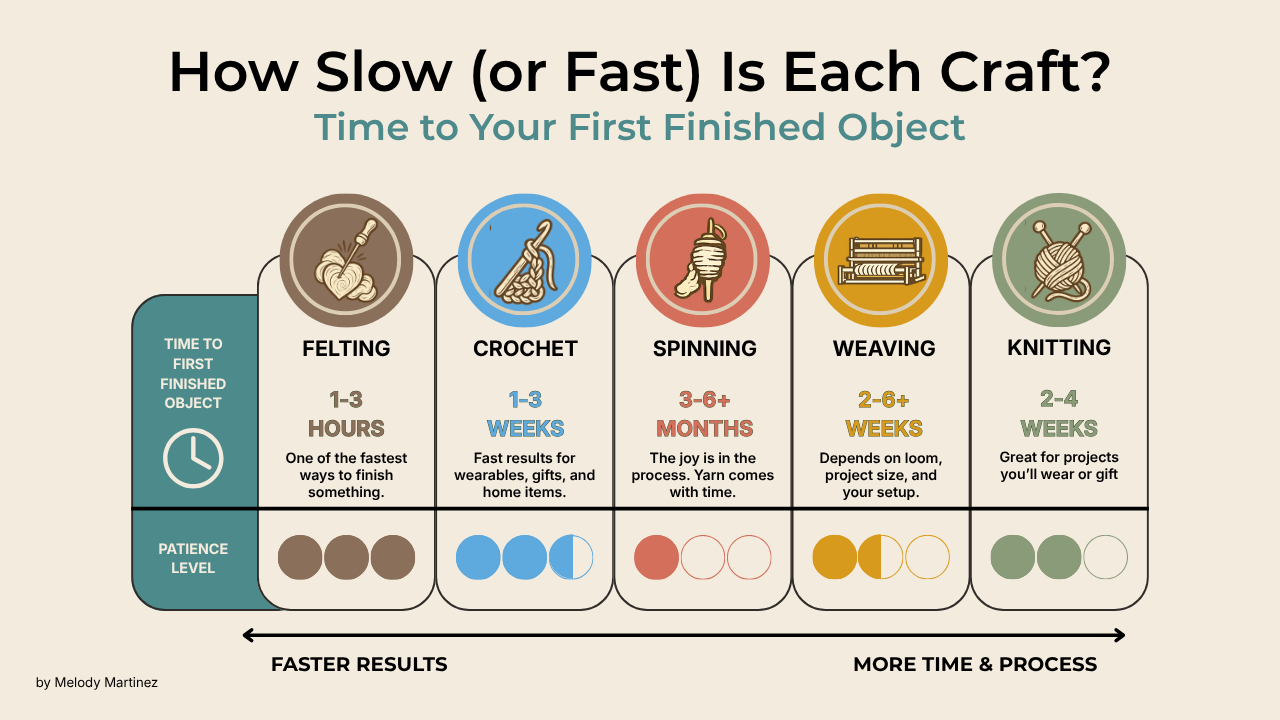
Question 2: What's Your Patience with Slowness?
What this means:
Fast: You want to finish something and wear/give/enjoy it quickly. You get discouraged by long projects.
Medium: You're willing to work on something for a month or two. You like watching progress.
Slow: You love the process more than the endpoint. You're happy spending months on spinning beautiful yarn, even if you don't knit it for another year.
Example: If you have a big event in 6 weeks and want to wear something you made, crochet is your answer. If you're in no rush and love watching fiber transform, spinning is your lane.
Question 3: How Do You Learn Best?
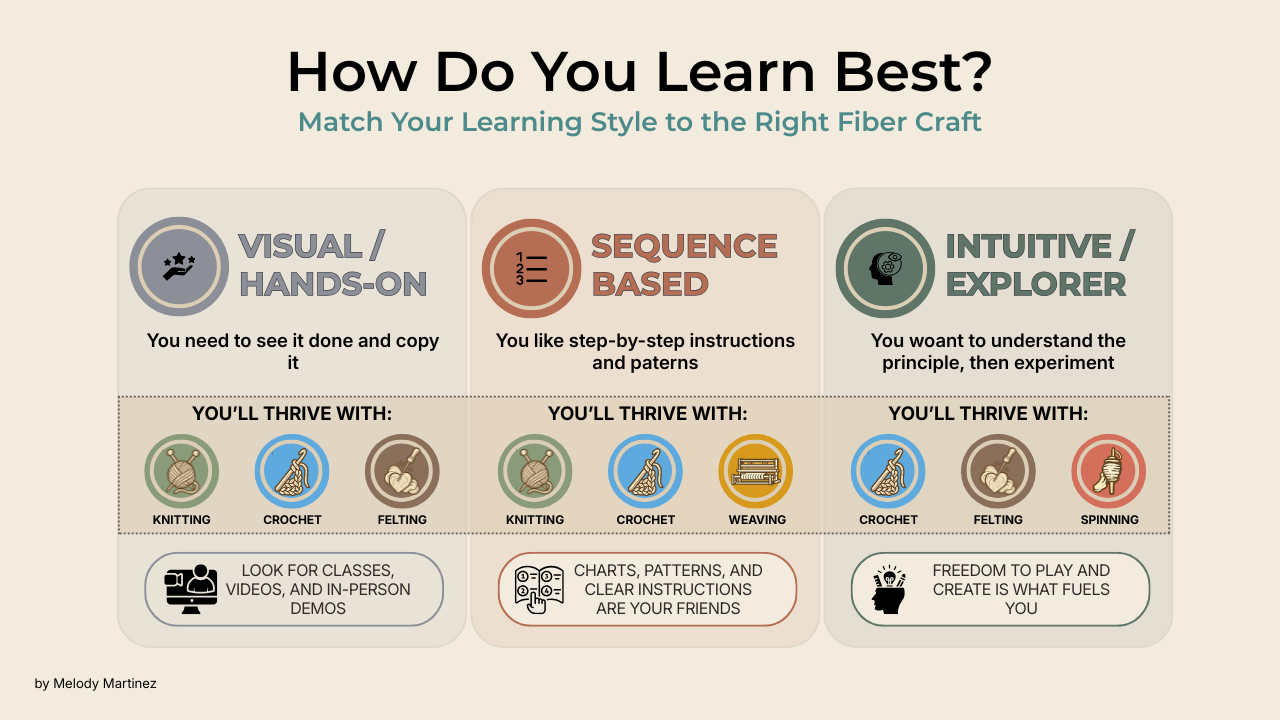
What this means:
Visual/Hands-On: You need to see it done and copy it. You're good with demonstrations and video tutorials.
Sequence-Based: You like following step-by-step instructions. Charts and patterns feel helpful, not restrictive.
Intuitive: You want to understand the principle, then experiment. You don't like rigid instructions.
Example: If you learn best by watching someone and copying them exactly, knitting (which has very standardized instructions) is forgiving. If you hate being told what to do and like figuring things out, crochet (which is more forgiving of mistakes) might suit you better.
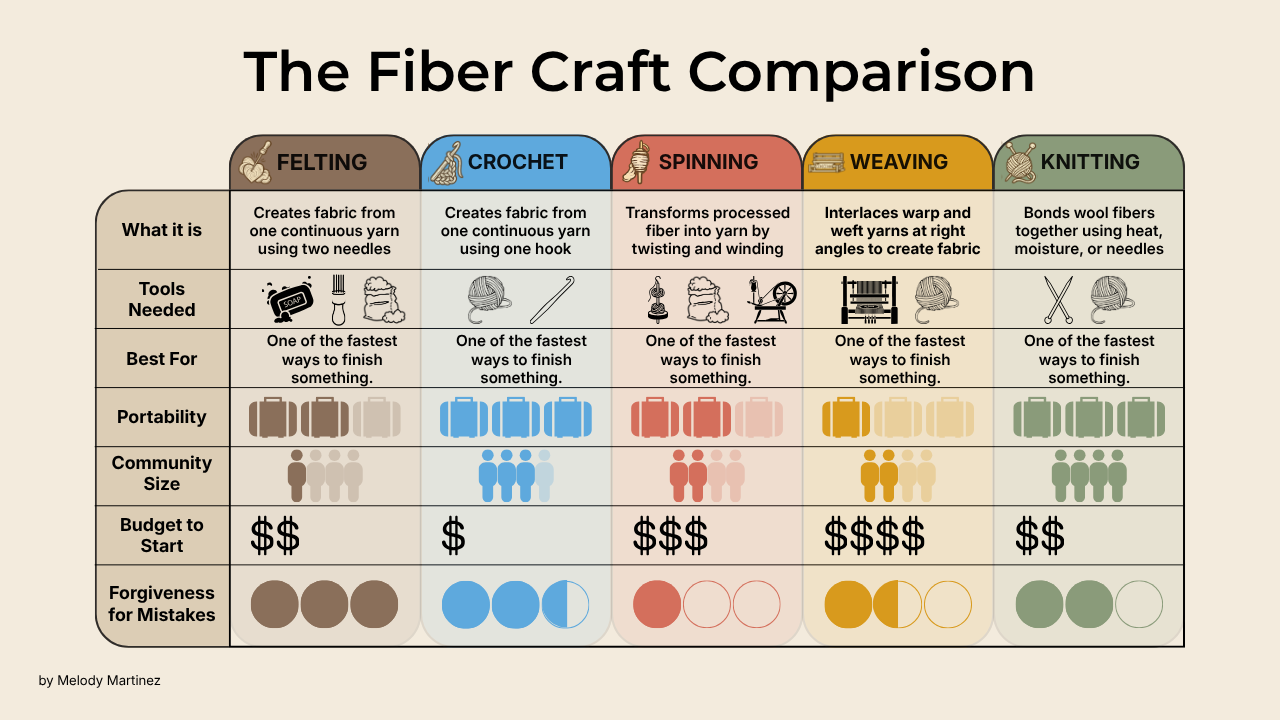
The Craft Comparison Table
Honest Assessments (What Others Won't Always Tell You)
Knitting
✓ Huge supportive community; easy to find groups and patterns
✓ Mistakes are fixable (usually)
✗ Can be repetitive and boring for some people
✗ Dropped stitches are your enemy
✗ Unfixable mistakes mean pulling out huge sections
Spinning
- ✓ Meditative and deeply satisfying
- ✓ Produces yarn you create yourself
- ✓ Open to artistic expression and experimentation
- ✗ Steep learning curve (expect months before you make usable yarn)
- ✗ Requires focus—can't do it while distracted
- ✗ Community is smaller; fewer teachers/groups
- ✗ Takes months to finish a project (spinning + making something from yarn)
Felting
- ✓ Fastest way to make something finished
- ✓ Most forgiving (mistakes become design features)
- ✓ Very little learning curve
- ✗ Repetitive (lots of agitation/poking)
- ✗ Physical (can be hard on hands)
- ✗ Smaller community
- ✗ Produces fabric, not yarn (different skill set)
Crochet
✓ More forgiving of mistakes (you can fix with one hook)
✓ Faster than knitting for most projects
✓ Great for people who like creative freedom
✗ Slightly smaller community than knitting (but still large)
✗ Can create holes/gaps if tension is loose
✗ Texture can look "lumpy" if stitches aren't even
Weaving
- ✓ Creates complex patterns and structures
- ✓ Results look impressive and professional
- ✓ Good for pattern-lovers and logical thinkers
- ✗ Expensive setup (looms cost $100-2000+)
- ✗ Less portable than other fiber arts
- ✗ Mistakes in setup can mean reweaving or restarting
- ✗ Smaller community; harder to find help
Real-World Scenarios: Which Craft Fits?
"I want to wear something I made within a month."
→ Crochet or felting. Crochet if you want a wearable (sweater, scarf). Felting if you want a small item (hat, bag).
"I like process more than product."
→ Spinning. The point IS the spinning, not what you make afterward.
"I have limited space and budget."
→ Knitting or crochet. You need needles/hooks and yarn. That's all.
"I like artistic freedom and don't want to follow patterns strictly."
→ Crochet or felting. Both allow more creative deviation.
"I'm a beginner and don't want to fail."
→ Crochet or felting. Both are forgiving of beginner mistakes.
"I want to make gifts that look professional."
→ Weaving (if you have space/budget) or crochet (if you want fast results). Both look polished.
"I want to join a group and have lots of community support."
→ Knitting or crochet. Largest communities, most groups, easiest to find help.
"I'm stressed and need something meditative."
→ Spinning. Hands-on, slow, rhythmic. No performance pressure.
"I like following detailed patterns and instructions."
→ Knitting. Knitting culture is very pattern-focused. Crochet is more improvisational.
At the Durango Festival: How to Choose
Watch demonstrations of all crafts. Pay attention not to what looks cool, but to how your hands feel watching the rhythm. Does the repetitive motion of knitting soothe you? Does the faster hook-work of crochet excite you? Does watching spinning feel meditative or boring?
Touch materials. Hold spinning fiber. Feel the difference between wool, alpaca, and cotton. Notice which textures appeal to you.
Ask vendors the honest question: "I'm trying to choose a craft. What should I know?" Most vendors will be brutally honest about learning curves and time investment.
Take a workshop if offered. Even a 30-minute demo can tell you whether you actually enjoy the physical sensation of a craft.
Don't commit yet. You don't have to decide at the festival. It's okay to leave and think about it.
After the Festival: Your Next Step
Once you've chosen:
1. Buy a beginner kit (needles/hooks + yarn, or fiber + spindle) from the festival if possible. Vendors often have starter packages.
2. Find a group. Search "[your town] knitting group" or "[your town] spinning guild." Most towns have them.
3. Watch one tutorial on the specific technique (cable knit, crochet granny square, drafting for spinning, weaving plain weave).
4. Give yourself 4 weeks before you judge whether you like it. The first two weeks feel awkward.